Why These Two Conditions Are Often Confused
It is common for people to mix up these two issues because, from the perspective of the patient, the initial hurdles feel nearly identical. Both conditions change the way your eye processes light by affecting how light focuses on the retina, leading to a breakdown in visual clarity. Patients with either issue frequently report blurred or distorted vision and significant difficulty seeing clearly at night. Because these early symptoms may feel similar to those of other conditions, a keratoconus eye exam in Newport Beach is often the only way to distinguish keratoconus from astigmatism. While they share a surface-level resemblance, an important distinction remains: these two conditions have very different causes and progression, as one is a stable refractive error and the other is a progressive corneal disease.
What Is Astigmatism
Astigmatism is not an illness or a disease; rather, it is a structural imperfection in the eye. It is incredibly common, affecting a large portion of the population to some degree. Most people with vision problems have some level of this condition. It often exists alongside nearsightedness or farsightedness. It simply means your eye is not perfectly round.
Instead of being shaped like a basketball, an eye condition that is shaped more like an American football, this egg-shaped curve means the eye has two different focal points.
Because the curve is uneven, light rays entering the eye are bent in different directions. This prevents a single, clear point of focus, making objects at all distances appear somewhat fuzzy.
Common Symptoms of Astigmatism
- Blurred or distorted vision: This is the most frequent sign, occurring at both near and far distances.
- Eye strain: Your eye muscles work harder to try to compensate for the blur, leading to fatigue.
- Headaches: Often a byproduct of the constant straining and squinting throughout the day.
- Difficulty with night vision: Seeing starbursts around lights while driving is a classic indicator.
Key Characteristics
- Often stable over time: For most adults, the level of blur stays relatively consistent year after year.
- Can be mild or moderate: Many people have such a small amount that they do not even require correction.
- Typically correctable with glasses, contacts, or refractive surgery: Standard tools work well here because the eye’s shape is predictable.
What Is Keratoconus
Common Symptoms of Keratoconus
- Increasing blurred vision: Unlike standard blur, this tends to get noticeably worse over months or years.
- Sensitivity to light: Bright sunlight or indoor lighting can become uncomfortable.
- Glare and halos: These visual artifacts are often much more severe than what a person with standard astigmatism experiences.
- Frequent changes in prescription: If you find yourself needing a new prescription every six months, it is a red flag.
- Difficulty correcting vision with glasses: Eventually, glasses may no longer provide 20/20 clarity because they cannot fully correct the cone-shaped refractive error.
Key Characteristics
- Progressive condition: It moves through stages, often starting subtly and becoming more severe.
- Often begins in teens or early adulthood: Most patients receive a diagnosis between their late teens and late 20s.
- Can worsen over time without treatment: Left alone, it can lead to scarring or the need for a transplant.
The Core Differences Between Keratoconus and Astigmatism
Cause
- Astigmatism: An irregular but stable curvature of the eye surface.
- Keratoconus: Structural weakening and thinning of the corneal tissue.
Progression
- Astigmatism: Usually stable throughout adulthood.
- Keratoconus: Progressive and may worsen significantly if not managed.
Severity of Distortion
- Astigmatism: More uniform distortion that is easily mapped.
- Keratoconus: Irregular, often more severe distortion that changes as the cone develops.
Correctability
- Astigmatism: Often corrected with glasses or standard soft contacts.
- Keratoconus: May require specialty rigid lenses or medical intervention to stop the thinning.
Why Early Keratoconus Is Sometimes Mistaken for Astigmatism
Patients may notice:
- Frequent prescription changes: If your vision is a moving target, it is rarely just standard astigmatism.
- Worsening vision despite correction: If your new glasses still feel off or ghosted, the cornea may be too irregular for a standard lens.
How Eye Specialists Accurately Diagnose the Difference
Comprehensive Eye Exam
This includes checking your vision problems and tracking how your refraction changes over time.Corneal Topography
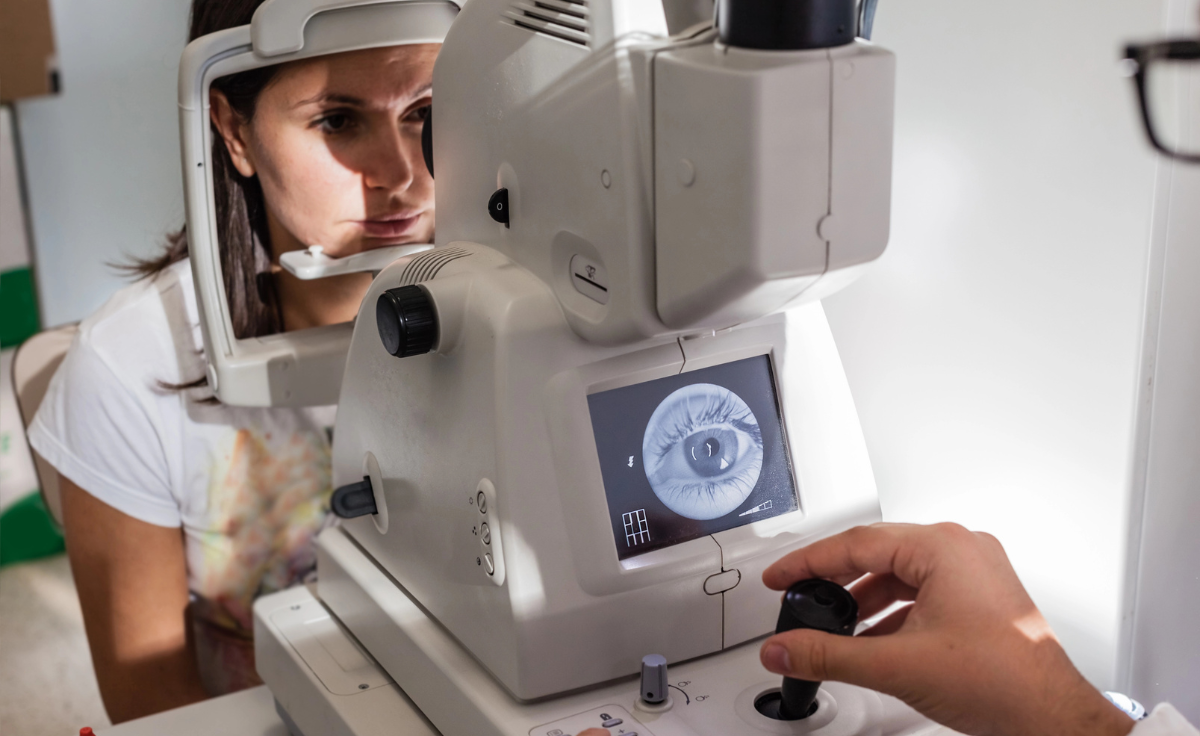
This is the gold standard for spotting a cornea disorder. It creates a 3D color map of the eye’s surface. A standard eye looks like a smooth hill; a keratoconus eye shows a hot spot where the cone is forming.
Corneal Tomography
This evaluates thickness and structural integrity. It looks at both the front and back of the cornea to see if thinning is happening before it even affects your vision.
Advanced imaging is critical for early detection of keratoconus. Without these maps, the subtle keratoconus early signs vs. astigmatism symptoms can remain hidden.
Why Early Detection of Keratoconus Matters
Time is a factor when dealing with a progressive corneal disease. The condition can progress without obvious symptoms early on. By the time you notice a major change, the cornea may have already thinned significantly. Having an early diagnosis allows for monitoring: Tracking the rate of change to decide when to act.
- Intervention to slow progression: Treatments like cross-linking work best when there is still plenty of healthy tissue left.
- Prevents more advanced vision impairment: Catching it early can mean the difference between wearing a contact lens and needing a surgical graft.
Treatment Differences
The treatment options for keratoconus vs. astigmatism vary depending on whether the goal is simply to clear up blur or to preserve the structure of the eye.
Astigmatism Treatment
- Glasses: The simplest way to redirect light.
- Contact lenses: Soft or toric lenses that sit on the eye.
- LASIK or PRK: These lasers reshape the cornea to make it more symmetrical.
Keratoconus Treatment
- Specialty contact lenses (RGP, scleral lenses): These create a new, smooth surface over the irregular cone.
- Corneal cross-linking: A procedure that uses UV light and riboflavin to strengthen the corneal fibers.
- Advanced procedures in later stages: If scarring occurs, more involved surgeries may be discussed.
Also Read: Living With Keratoconus: Long-Term Management Options
When to See an Ophthalmologist
If you live in Orange County and notice these shifts, a keratoconus eye exam in Newport Beach is a wise move. Watch for:
- Rapidly changing vision that requires new glasses every year.
- Increasing astigmatism in only one eye.
- Difficulty seeing clearly, even with correction.
- Sensitivity to light or glare that makes night driving dangerous.
Choosing the Right Eye Care Provider
When your sight is on the line, the tools and the talent behind them matter. Identifying the difference between keratoconus and astigmatism requires more than just a wall chart.
- Importance of advanced diagnostic technology: Mapping the cornea is the only way to be sure of a diagnosis.
- Experience with corneal conditions: A specialist sees the patterns that a generalist might overlook.
- Ability to differentiate early-stage disease: Early intervention is the best way to keep your lifestyle intact.
At Soroudi Advanced LASIK & Eye Centers, the focus is on providing clear answers backed by detailed data. Whether you have a stable refractive error or a condition that needs active management, getting the right diagnosis is where the path to clarity begins.
Setting Realistic Expectations
- Astigmatism is common and manageable: It is a hurdle, but one that is easily cleared with the right pair of lenses or laser work.
- Keratoconus requires monitoring and sometimes treatment: It is a journey that requires a partnership with your doctor.
- Early diagnosis can significantly impact long-term outcomes: The sooner you know what you are facing, the more control you have over your future sight.
Schedule a Comprehensive Eye Evaluation
If your vision continues to change or you’ve been told you have astigmatism that is getting worse, a more detailed evaluation may be appropriate. At Soroudi Advanced LASIK & Eye Centers, advanced imaging and diagnostic tools are used to identify conditions, such as keratoconus, early and to guide appropriate treatment.